
Earlier in the week I was working with the first and second graders on how to write poetry. After talking about word choice and formatting, I gave them the topic of writing about a favorite toy. One student said he didn’t play with toys and, given my observations of his play over several years, I understood exactly what he was saying. He’s a child who always has a plan and a clear idea how to execute it. His play is truly work, and his materials here at school are bricks, boards, rocks, sticks, and any other natural material available. No toys are involved.
I’ve thought about this for several days, and also reflected on our building area of the playground. I was out there this morning and was astounded with the variety of engagement I saw from children of all ages. For a starter, an adorable group of three-year-olds was sitting on a circle of bricks. One child said, “We’re making an office.” Pointing to her friends, she added, “They are veterinarians.” Nearby another group of elementary students was working on a structure of large branches propped up against a tree. The same girls have been working on their “tent” for several weeks, continually revising the structure and its materials. One element of their play is that they’ve been inclusive of younger children helping out, incorporating their ideas as much as possible.
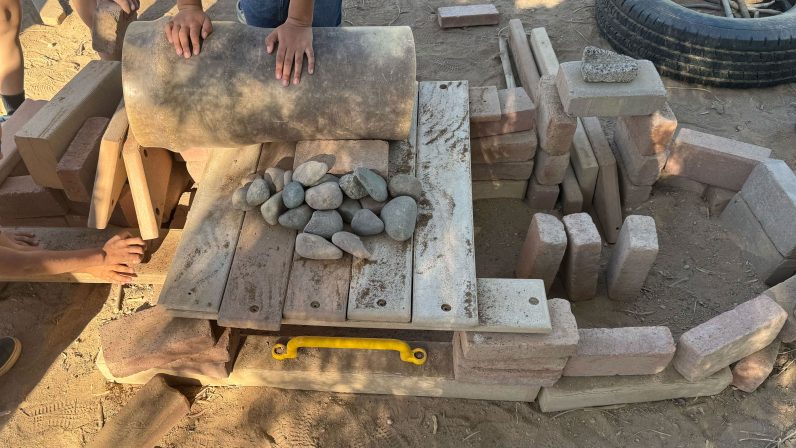
Yet another assembly of children were enthusiastically involved with building a bowling alley, which evolved from being a car repair place the day before. They set up three bricks and then used a long board (covered with fine dust) as the alley where roundish river rocks were slid along the board to knock over three bricks. They even installed a large pipe for a ball return. Children would take turns, making sure the little kids had a chance to try along with the more skilled “bowlers.” There were numerous opportunities for social learning that accompanied this play, including taking turns, reading the situation before moving in to dismantle something, and cooperation. This activity was sustained for over an hour.
As all this was going on, a kindergartener approached me in Gwen’s Castle with a broken pecan shell in his hand. He asked what it was. I told him about a nearby pecan tree and how the birds often carry the pecans to our playground, crack them open and eat the nut inside. He wanted to know how they crack them open, and I honestly said I didn’t know exactly how they do it. He walked off, shell in hand, apparently satisfied with my answer.
Back in the greater building space, the preschoolers who were veterinarians had evolved into singers. They created a little performance area and one child was singing her version of “Golden” from KPop Demon Hunters. As I looked around, observing children of all ages working and playing together, a thought that has been on my mind all week returned: These children have no idea how rare and precious it is to be able to play in this way. They have access to natural objects and other materials that invite them to invent, create, and build with open-ended freedom. What they do and learn by playing this way is going to affect the rest of their lives in ways that will be revealed much later. It’s moments like these that make it clear how important our work at the Seed is, for these particular children and generations to come. Little by little, we change the world.