
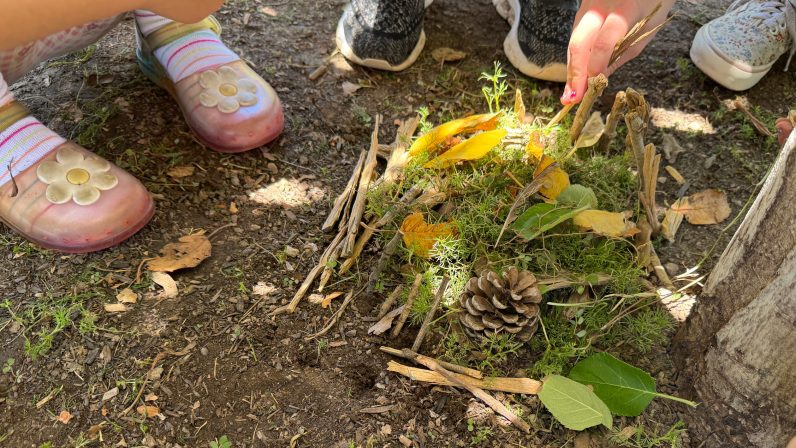
On Monday a small group of children huddled under the apple tree during morning recess, evidently engaged in something. I approached them and started asking questions. One child, the apparent leader of the project, explained that they’d found a dry, brown leaf with two tiny white eggs attached. Looking closer, I could see that one had already hatched, and the other had not. They had given the remaining one a name, Leaflon.
They carefully guarded Leaflon by piling up dried leaves and weeds from the grass. Additionally, sticks were poked into the ground to form a small fence for protection. They stayed there for over an hour before school started, and all throughout noon recess for more than two days. When I checked in on them, they mentioned their concern about other kids running by that might disturb Leaflon or throw a ball at it.
One the second day I received word that one child had written up plans for Leaflon’s care, and another child was reportedly up during the night, concerned about Leaflon and drawing maps for further care planning. Their continuing compassion and concern were impressive.
On day three when I checked in, they were having a discussion about upcoming water play day, and what would happen if water got on Leaflon. I added that another concern was when we’d be having our next irrigation day. They asked what that was, and I explained that the entire grass area would be flooded. Upon realizing this, at my suggestion, they decided to relocate their project over by Gwen’s Castle.
This morning, before starting my writing, I decided to check on Leaflon. I walked out to the Castle and didn’t see the little white egg anywhere. So I found the chief guardian and, anticipating that she might be upset by Leaflon’s disappearance, asked what happened. The child matter-of-factly said she wasn’t sure. Then she added, “I looked up caterpillar eggs and those weren’t caterpillar eggs.” Then she added cheerfully that one of the children was going to bring caterpillars from home for all of them. We concluded our conversation by agreeing that this is often how nature is, that sometimes we just don’t know the answers to what happens.
While talking with one of our staff about this occurrence, he said it’s really a summer kind of thing. That stayed in my mind. It reminded me of summer days as a child when we had seemingly infinite hours to explore and interact with nature. I’m glad the Seed summer program provides these opportunities for children, where they have open-ended chances to stay with and revisit something in the natural world that is driven by their own interests.
This particular situation also revealed the innate level of care, curiosity, and compassion children are capable of when placed in an environment that provides invitations to practice these qualities. Seeing how devoted they were to Leaflon’s wellbeing also gave me hope for the future of our planet. At a time when our world seems unpredictable and headed in a tenuous direction, knowing there are forthcoming citizens with this kind of heart inspires me to keep working for the benefit of all beings.
This is one reason why Jack misses Mary and his years at the Seed. We talked about it this week. We all miss our years at the Seed and we all love “our” Mary.
Yes! Something so special about the seeds playground, the magical trees, soft green pastures, encounters with so many different animals and insects. I just love being out there and seeing our little friends collect leaves, cicada shells and rocks like the treasure’s they really are.