
As part of our 50th year experience, Danielle and I are intentionally reflecting on our mission statement, looking at it with fresh eyes. In a previous post I described the work we did with staff to create vision boards that was an expression of our intentional reflection. Currently, I’ve turned my focus to innovation.
From my perspective, innovation is an intersection of creativity and problem solving. On a staff level, we practice both on a daily basis. The way teachers set up their classrooms, how scheduling is managed to maximize coverage and keep children safe, and systems put into place for sharing materials are all ways we innovate here at the Seed. In classrooms, children have access to materials and equipment, such as all different types of blocks, that invite both problem solving and creativity. Teachers pair specific equipment to create new opportunities for thinking.
One area of the curriculum we’ve been emphasizing to promote innovation is art. We’ve challenged the staff to use recycled materials as much as possible this year. Random cardboard pieces cut into large and small pieces become sculptures, self portraits, and 3-D collages. Once the glue is dry, paint is added to bring the work to life. The two oldest classes have worked on larger installations of multi-textured recycled materials glued to big pieces of cardboard. Once the shapes and textures are adhered to the background, the installations will be given to our youngest classes for students to paint as a class. This is an example of an innovation that also builds community.
Teachers have been invited to include more process art in their lesson plans this year. Process art focuses on open-ended creative experiences rather than specific teacher-selected projects. In the words of bell hooks, “The function of art is to do more than tell it like it is – it’s to imagine what is possible.” Process art is showing up at all levels. Toddlers are given blank paper, paint, and various materials for making marks. Scribbles become family maps. Preschoolers jump at the opportunity to make gigantic marks on large mural-sized paper, using markers, watercolors, and pencils. In after school, the teacher tapes smaller pieces of paper to the table, inviting young students to add their marks with stamps, markers, and tempera paint. These “art papers” are then cut into smaller pieces and used for other projects.
Elementary students often work on pieces in layers. For example, a photo of a student is glued to a cardboard base, then the child makes choices about how to use oil pastels, miscellaneous collage pieces, and tempera paint, to enhance their self-portrait. A recent project involved using the edge of a used gift card to print marks on paper. Once dry, they’ll be invited to add new layers of paint, tissue paper, and other media to add dimension to their work. If a child chooses to smear paint around with the card instead of printing with it, that’s fine. One teacher gave students tempera paint and Sharpies to create backgrounds on which to place the letters of their names. These turned out beautifully unique.
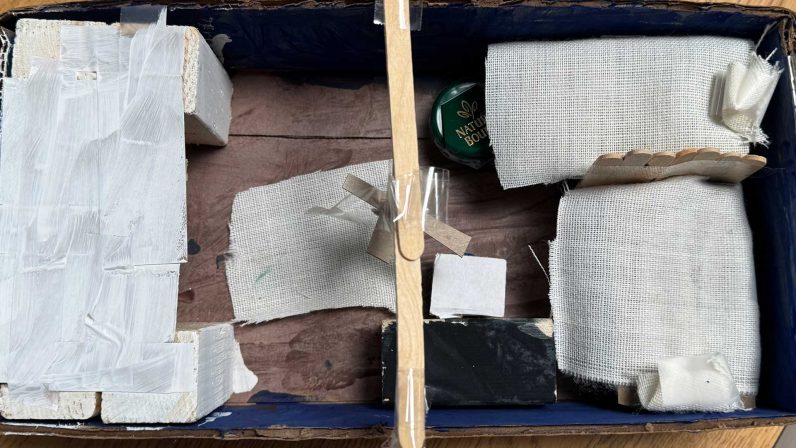
The 3rd/4th graders are taking innovation to a new level with a project tied to a writing assignment. Each child has written a personal piece about their bedroom, describing what it looks like, a favorite item, and how their bedroom makes them feel. They have each made a list of items in their room and made a sketch of the floor plan. Each student was given a small box and asked to create a model of their room that includes items from their list. Gradually, miniature loft beds, bookshelves, and ceiling fans are popping up in their boxes. One reason I like assignments like this is, in addition to writing and art, it touches on aspects of our social justice curriculum regarding development of a healthy identity. Across the board, any time a child is given a chance to use their creativity and make their own choices for self-expression, it builds a stronger sense of self. Children who have these experience grow up to be humans who change the world.
(art work by Jack Jones)